
EMBRYOLOGY
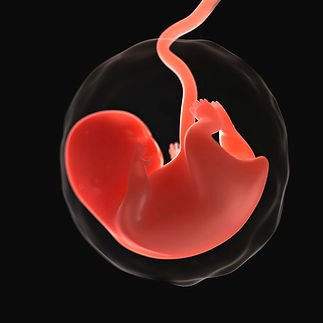
Embryology is the branch of science that studies the development of living organisms from fertilization to birth. Anatomical approaches dominated early embryological investigations. Observations were made by the naked then by microscopes. Approaches became more sophisticated with advances in optical equipment, specimen preparation methods and microdissection techniques. Comparative developmental studies and investigation on birth defects lead to deeper understanding of developmental processes and the science of embryology as a whole. Teratology emerged as a science wholly concerned with birth defects (congenital abnormalities) their causes and treatment. Expermintal embryology also emerged as a branch of science that focuses on the processes of cell differentiation, induction of differentiation, determination and interactions of cells of developing embryos and fetuses. Vital staining of living cells, radioactive labeling and autoradiographic techniques paved the way for the expansion of this branch of embryology. More recently, the employment of genetic markers in embryological studies opened into a new era in the field of embryology.
History
From the time of the Greek philosopher Aristotle it was debated whether the embryo was a preformed, miniature individual (a homunculus) or an undifferentiated form that gradually became specialized. Supporters of the latter theory included Aristotle; the English physician William Harvey, who labeled the theory epigenesis; the German physician Caspar Friedrick Wolff; and the Prussian-Estonian scientist Karl Ernst, Ritter von Baer, who proved epigenesis with his discovery of the mammalian ovum (egg) in 1827. Other pioneers were the French scientists Pierre Belon and Marie-François-Xavier Bichat.
Baer, who helped popularize Christian Heinrich Pander’s 1817 discovery of primary germ layers, laid the foundations of modern comparative embryology in his landmark two-volume work Über Entwickelungsgeschichte der Thiere (1828–37; “On the Development of Animals”). Another formative publication was A Treatise on Comparative Embryology (1880–91) by the British zoologist Frances Maitland Balfour. Further research on embryonic development was conducted by the German anatomists Martin H. Rathke and Wilhelm Roux and also by the American scientist Thomas Hunt Morgan. Roux, noted for his pioneering studies on frog eggs (beginning in 1885), became the founder of experimental embryology. The principle of embryonic induction was studied by the German embryologists Hans Adolf Eduard Driesch, who furthered Roux’s research on frog eggs in the 1890s, and Hans Spemann, who was awarded a Nobel Prize in 1935. Ross G. Harrison was an American biologist noted for his work on tissue culture.


