
Nervous Tissue
Updated: Apr 14
The nervous system is the body’s command center; it is a complicated system comprising the central nervous system that consists of the brain and spinal cord, and the peripheral nervous system that includes ganglia, nerve trunks, nerves and nerve endings. The nervous system is made up of the nervous tissue, which is one of the four primary tissues of the body. The main parts of the central nervous system are the cerebrum, cerebellum, medulla and the spinal cord.
The Cerebrum
Cerebrum is the largest part of the brain; it handles conscious thoughts and actions. Different areas within the cerebrum have different responsibilities like language, behavior, sensation and processing.
Embryologically, the cerebrum develops from the cephalic part of the neural tube, that enlarges to form five vesicles known as the brain vesicles and called telencephalon, diencephalon, mesencephalon, metencephalon and myelencephalon. The cerebral hemisphere develop form the lateral telencephalic vesicles which are outpocketings of the telencephalon. The cerebellum develops from the alar plates of the 4th brain vesicle, which is called the metencephalon. Cavities of the brain vesicles give rise to the ventricles of the brain.
The Cerebral Cortex
The cerebral hemispheres lie within the cranium covered by the pia mater, arachnoids and dura mater. Each hemisphere consists of an outer part made of grey matter known as the cortex, and an inner region known as the white matter. The cerebral cortex contains cell bodies of different types of neurons, in addition to glial cells, nerve fibers and blood vessels. Nerve cell bodies present in the cerebral cortex are arranged in six ill-defined layers in several parts of the cerebrum, and 3-5 layers in other part. Regions that contain six cortical layers include the association cortex, motor areas of the cerebral cortex and sensory areas of the cerebral cortex. The olfactory cortex has the least; it has 3 layers only; it is a primitive cortex. The cerebrum initiates and coordinates movement and regulates temperature. It also enables speech, judgment, thinking, reasoning, problem-solving, emotions, learning and sensation. The six layers of the cerebral cortex are as follows from outside inwards:
1. Molecular (plexiform) layer
1. Outer granular layer
2. Outer pyramidal cell layer
3. Inner granular layer
4. Inner pyramidal (ganglion) cell layer
5. Polymorphic (multiform) cell layer

Types of Neurons in the Cerebral Cortex
The cerebral cortex contains five different types of neurons; they are known as the:
1. Pyramidal cells
2. Stellate cells
3. Fusiform cells
4. Martinotti cells
5. Horizontal cells of Cajal
It is quite difficult to differentiate between these cells in routinely stained histological sections; they need to be stained by special staining techniques before they can be identified.
Layers of the Cerebral Cortex
The molecular layer is the superficial outermost layer of the cerebral cortex; it is also known as the plexiform layer. It contains sparsely scattered horizontal cells of Cajal, and numerous unmyelinated nerve fibers, which give the layer a fine fibrillar appearance. Nerve fibers of the molecular layer are axons and dendrites of different types of nerve cells that have cell bodies in the other layers of the cerebral cortex. They include dendrites of the pyramidal cells, axons of the stellate cells, centrifugal axons of Martinotti cells, and projection and association fibers passing into the cerebral cortex from underlying white matter.
The outer granular layer lies beneath the molecular later and contains the cell bodies of the stellate neurons and, in addition to axons and dendritic processes of Martinotti cells and pyramidal cells.
The outer pyramidal layer contains the cell bodies of the medium sized pyramidal cells. This layer also contains stellate or basket cells and the vertically orientated fusiform cells, in addition to axons and dendrites of stellate cells, Martinotti cells and the medium-sized pyramidal cells.
The inner granular layer contains the cell bodies of the stellate cells, and a few small pyramidal cells, along with their axons and dendrites.
The inner pyramidal or ganglionic cell layer contains cell bodies of the large pyramidal cells, in addition to a few stellate cell and small pyramidal cells. It also contains nerve fibers which are axon and dendrites of the pyramidal cells and the fusiform cells.
The multiform or polymorphic cell layer contains the cell bodies of a wide range of cell types including pyramidal cells, fusiform cells and Martinotti cells, which are often the commonest cell type in this layer.
The vast majority of the nerve fibers present in the cerebral cortex are unmyelinated.

Neurons of the Cerebral Cortex
The cerebral cortex contains five types of neurons distributed to the different levels and layers of the cortex. These are the pyramidal cells, stellate cells, Martinotti cells, fusiform cells and the horizontal cells of Cajal.
Pyramidal Cells
The pyramidal cells are Golgi Type-I motor neurons that have large cell bodies and an extremely long axon. Their cell bodies are pyramidal and of variable size; they are located in the outer and inner pyramidal cell layers of the cortex. Each cell has a long dendrite that emerges from the perikaryal apex and passes upwards towards the molecular layer. Also, there are shorter dendrites that extend laterally from the basal angles of the cell body. The pyramidal cell axon is very long; it emerges from the base of the cell body and passes down towards the white matter. The axon may give lateral branches that may reflexively influence the cell of its origin via interneurons. The largest of the pyramidal cells are known as Betz cells. Pyramidal neurons, account for approximately 80% of all cortical neurons and serve as both the sole output channel of the cerebral cortex and the largest input system to the cortex.
Stellate Cells and Martinotti Cells
Stellate cells and Martinotti cells are both Golgi type-II neurons; they are small neurons with small dendrites. Stellate cell bodies appear star shaped in silver-stained sections; they have many short stout dendrites. These cells are also known as granules cells on the basis of their appearance in H&E sections.
Martinotti cells have more slender short dendrites; their cell bodies appear polygonal, and their axons extend towards the molecular layer, bifurcate there and pass horizontally in the outer molecular layer.

Fusiform Cells and horizontal cells of Cajal
Both of these two types of neurons have small spindle shaped cell bodies. Horizontal Cajal cells –as their name implies- are oriented horizontally. Their cell body, axon and dendrites are oriented parallel to the surface of the cerebral cortex. Horizontal cells of Cajal and their processes are confined to the molecular layer.
Cell bodies of the fusiform neurons are located in the deeper parts of the cortex; their cell bodies, axon and dendrites are oriented vertically. The axon passes towards the molecular layer. The arrangement of nerve cell bodies is the cause of layering of the cerebral cortex (layers 1-6).
Neuronal Connections in the Cerebral Cortex
Afferent fibers enter the cerebral cortex from the deepest layer, the polymorphic cell layer. They climb up across all above layers making synaptic junctions with neurons in different layers, namely with pyramidal cells, basket cells, Martinotti cells and horizontal cells of Cajal. The horizontal cells receive input from extracortical projection fibers and from axons of Martinotti cells. Their efferent output passes to the pyramidal cells and leaves the cerebral cortex via axons of the pyramidal cell. There are lots of modulatory synaptic junctions between the different types of cortical neurons.

The White Matter
The white matter of the cerebrum consists of nerve fibers, neuroglial cells and blood vessels. The nerve fibers are abundant and form thick fascicles. Large groups of neuronal cells bodies are found in-between these fascicles forming nuclei of different size, shape and functions. These nuclei are occasionally referred to as ganglia, though ganglia are by definition, collections of nerve cell bodies outside the CNS. The nerve fibers of the white matter are mostly myelinated fibers that pass to and from the cerebral cortex. They are classified into 3 types: association fibers, commissural fibers and projection fibers. Association fibers, long or short, connect various regions of the cerebral cortex within the same hemisphere. Commissural fibers connect corresponding regions of the right and left cerebral hemispheres, whereas projection fibers (afferent or efferent) connect the cerebrum with other parts of CNS. They constitute the corona radiata and internal capsule.
The Cerebellum
The cerebellum is an important component of the human brain; it plays a significant role in regulation of motor movements and control of balance. The cerebellum coordinates gait and maintains posture, controls muscle tone and voluntary muscle activity but cannot initiate muscle contraction. It also plays a role in some cognitive function such as language processing. It has three functional areas, which are the cerebrocerebellum, the spinocerebellum and the vestibulocerebellum. The cerebellum is highly folded and consists of an inner white matter and an outer grey matter known as the cerebellar cortex.
Cerebellar Cortex
The cerebellar cortex is characterized by deep folds known as folia. It has three histologically distinct layers:
1. Molecular layer (Outer)
2. Purkinje cell layer (Middle)
3. Granular layer (Inner)
The cerebellar cortex is the gray matter of the cerebellum, so it contains nerve cell bodies. It contains the perikarya of five different types of neurons arranged in three layers. The five types of neurons are Purkinje cells, basket cells, granule cells, Golgi cells and stellate cells. In addition to nerve cell bodies, it contains different types of neuroglial cells, nerve fibers which are mostly unmyelinated, as well as capillaries and small blood vessels. The nerve fibers can only be clearly visualized using special stains such as silver nitrate staining methods.

Molecular Layer
This layer is composed of numerous fine unmyelinated fibers, a few stellate neurons, basket cells and glial cells, in addition to blood vessels. Due to abundance of unmyelinated fibers, the layer appears fibrillar. The nerve fibers are a mixture of Purkinje cell dendrites, climbing fibers reaching the cerebellum from the inferior olivary nuclei, axons of granule neurons ascending from the granular layer, and processes (axons and dendrites of basket cells and stellate cells whose cell bodies are present within the molecular layer itself.
Purkinje Cell Layer
This layer is narrow and can be overlooked in low power magnifications. It is made up of a single row of Purkinje nerve cell bodies. Purkinje cells are huge pear-shaped neurons with several dendrites and a single axon. The dendritic arborizations extend upwards into the molecular layer where they receive thousands of synaptic inputs. Their axons are extremely long; they pass downwards traversing the granular layer and pass into the white matter to reach the deep cerebellar nuclei; Purkinje cell axons constitute the sole efferent output of the cerebellar cortex,
Granular Layer
The granular layer is packed with numerous small neurons called the granule cells. These are small neurons characterized by dense spherical nuclei, that impart a dense granular appearance to this layer. Granule cells are the most numerous types of neurons in the brain. They are glutaminergic neurons which use glutamate as their neurotransmitter. Glutamate is a common CNS excitatory neurotransmitter. Granule cells have short dendritic processes that receive synaptic input from the mossy fibers. Their axons pass into the molecular layer where they bifurcate forming parallel fibers, each fiber synapses with dendrites of several Purkinje cells. The granular layer also contains another cell types called Golgi cells. The dendrites of Golgi cells extend into the molecular layer whereas their axons synapse with granule cell dendrites in the vicinity.
Neurons and Fibers in the Cerebellar Cortex
Mossy and climbing fibers traverse the white matter and pass into the cerebellar cortex. Mossy fibers originate in the brain stem nuclei and terminate within the granular layer of the cerebellar cortex whereas the climbing fibers originate in the inferior olive and climb into the molecular layer of the cerebellar cortex. One mossy fiber influences several Purkinje cells via a single granule cell, whereas a climbing fiber influence only one Purkinje cell.

Cerebellar White Matter
The cerebellar white matter has a characteristic branching-tree-like appearance. Branches of the white matter are covered by the gray matter. The white matter is devoid of nerve cell bodies; it is primarily made of parallelly arranged myelinated nerve fibers. The myelin sheathes of the numerous myelinated nerve fibers is what gives the white matter its white colour. Nerve fibers present in the cerebellar white matter include mossy fibers, climbing fibers and axons of Purkinje cells. Mossy fibers origine in the spinal cord and the inner ear and reach the cerebellum via the pontine nuclei, whereas the climbing fibers originate in the cerebrum and reach the cerebellum via the inferior olivary nuclei. Axons of Purkinje cells originate in the Purkinje cell layer of the cerebellar cortex, pass down into the cerebellar white matter and terminate within deep cerebellar nuclei.
The deep regions of the cerebellar white matter contain aggregations of nerve cell bodies known as the cerebellar nuclei. There are four pairs of cerebellar nuclei, each contains nerve cell bodies and nerve fibers. The vast majority of these nerve fibers are unmyelinated fibers. Absence of myelin and presence of nerve cell bodies impart a gray colour on all CNS nuclei.
The Thalamus
The thalamus has five functional components, namely the reticular and intralaminar nuclei which are involved in arousal and pain regulation, the sensory nuclei which receive all sensory inputs except olfaction, the effector nuclei which govern motor language functions, and the associative nuclei which connote cognitive functions. The thalamic nuclei are clusters of densely packed nerve cell bodies and groups of nerve fibers, which mostly are unmyelinated.
The Substantia Nigra
The substantia nigra is a midbrain dopaminergic nucleus, which has an important role in modulation of the motor movements. It is a large mass of grey matter extending throughout the midbrain; it is easily recognized by the appearance of its neurons which contain dark pigment give the substantia its name. The substantia nigra has extensive connections with the cortex, spinal cord, corpus striatum and reticular formation and appears to play an important part in the fine control of motor function. Neurons of the substantia nigra are multipolar that contains numerous of neuromelanin pigment granules. The pigmented neurons of the substantia nigra contain dopamine, which is a neurotransmitter that has an inhibitory effect on neurons of the corpus striatum. Neuromelanin is contained in membrane-bound vesicles that appear as electron dense granules. The amount of neuromelanin within these dopaminergic neurons is meager in newborns and early children; its amount increases gradually during adolescence, adulthood, reaching its maximal levels in the elderly. Neuromelanin is thought to be either synthesized on purpose or just a byproduct of dopamine synthesis.
Medulla Oblongata
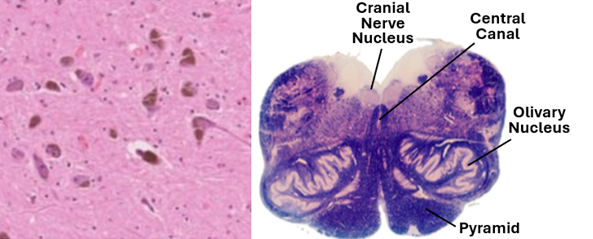
The medulla oblongata is the most caudal part of the brainstem that connects to spinal cord. It has prominent bilateral ventral pyramids which contain corticospinal tracts that transmit voluntary motor signals from the motor cortex to alpha motor neurons in the anterior horns of the spinal cord. The vast majorly of these fibers cross to the opposite side in the decussation of the pyramids. All of the ascending sensory pathways of the spinal cord pass through the medulla oblongata. The medulla contains several ascending and descending tracts. The tract fibers pass upwards to the thalamus via the medial lemniscus. It also contains nuclei of several cranial nerves; these are aggregations of nerve cells bodies. Gradually, the gray matter of medulla oblongata assumes a butterfly appearance similar to that of the spinal cord. The ventral grey matter horn on each side contains cell bodies of lower motor neurons running in the spinal accessory and first cervical nerve. The medulla oblongata contains the terminal parts of 4th ventricle that opens into the spinal canal, via the calamus scriptoriums.
the Spinal Cord
The spinal cord is a long hollow cylindrical structure that runs from the brain to the lower back. It is made up of nervous tissue and is invested by the meninges. The spinal cord has a thick wall surrounding a small central canal. It has a posterior (dorsal) sulcus and anterior (ventral) fissure. The central canal is lined by ependymal cells and contains cerebrospinal fluid. The appearance of the spinal cord varies slightly at different levels of the cord. The wall of the spinal cord comprises a white matter to the outside and gray matter to the inside; reverse of the situation in the cerebrum and cerebellum.
The spinal cord is ectodermal in origin. It develops from the neural ectoderm. The ectoderm of the trilaminar staged embryo thickens at the midline to form the neural plate. This plate invaginates and form a neural groove, the groove’s side ridges fuse and the groove transforms into a tube called the neural tube. The cranial parts of the tube expand to form the brain vesicles whereas the remainder maintains its tubular shape. The spinal cord develops from this caudal uniformly tubular part of the neural tube. The tube wall thicken and the lumen becomes narrower. The wall then differentiates into three layers: the ependymal layer, mantle later, and marginal layer. The mantle layer which is middle zone proliferates rapidly to form the gray matter, divided into a ventral basal lamina and dorsal alar lamina separated by the sulcus limitans. The basal lamina develops into the motor area, giving rise to anterior and lateral horns. The alar lamina develops into a sensory area that gives rise to the posterior horn. The lumen becomes narrow forming the central canal and ependymal layer differentiate into ependyma that lines the central canal. Stem cells of the mantle layer differentiate into neuroblasts and glioblasts; the former develop into neurons, and the latter develop into neuroglial cells, except for microglial cells which develop from blood monocytes. Axons of these new formed nerve cells grow towards the marginal zone forming nerve bundles that extend upwards forming ascending and descending tracts within the marginal zone, that subdivide this region into anterior, posterior, and lateral white columns.

Structure of the Spinal Cord
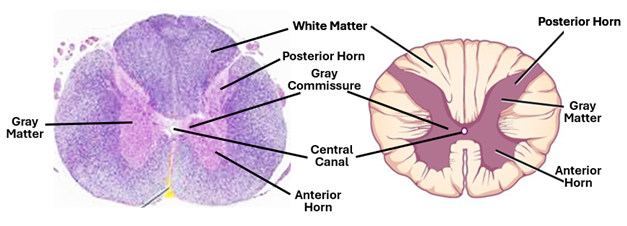
The spinal cord is made of is a cylinder of nervous tissue surrounding a narrow central canal. The nervous tissue is of two types, gray matter and white with names given because of their fresh state gross colours. The gray matter is located deeply, surrounded by the white matter. In histological cross-sections of the spinal cord, the gray matter takes the shape of butterfly, a wing on either side connected by a horizontal bar known as the gray matter commissure. The upper (dorsal, posterior) part of the wing is called the dorsal or posterior horn of the gray matter, whereas the lower (ventral or anterior) part of the wing is called the ventral of anterior horn. The posterior horn is sensory receiving afferent nerve inputs, whereas the anterior horn, which is larger than the posterior is motor in nature, giving the efferent nerve output. The gray horn appears eosinophilic in H&E-stained sections because it contains nerve cell bodies and myelinated nerve fibers, whereas the white matter appears foamy because it is essentially made of myelinated nerve fibers that lose their myelin during tissue processing; myelin dissolves in the reagents used for tissue processing.
The Central Canal
The central canal is the small cylindrical cavity that runs throughout the spinal cord; it is located in the deep parts surrounded by the nervous tissue of the cord. It is located in the middle of the horizontal gray commissure which connects the right and left wings of the gray matter. It contains the cerebrospinal fluid (CSF), a fluid that fills all cavities of the CNS including the brain ventricles and the central canal of the spinal cord.
The central canal is lined by ependyma, which is a single layer of absorptive columnar cells. Junctional complexes anchor ependymal together cells contributing to the formation of the CSF-nervous tissue barrier; this barrier prevents CSF-borne organisms and harmful substance from accessing the nervous tissues underlying the ependyma. The apical surface of ependymal cells has numerous long microvilli and a few cilia that together impart a hairy appearance to the ependyma’s luminal surface. The microvilli facilitate absorption of the CSF, whereas the cilia help in CSF percolation. Ependymal cells have long basal processes that pass into the underlying nervous tissue and communicate with nerve cell processes.

The Gray Matter
The gray matter of the spinal cord usually has the shape of a butterfly-shape. The two butterfly wing-like halves of the gray matter are connected by a central commissure that immediately surrounds the central canal. Each wing has a posterior (dorsal) horn and an anterior (ventral) horn. A small lateral horn is present between the two horns in thoracic and upper lumbar regions where there is sympathetic outflow. The gray matter is made of nerve cell bodies, nerve fibers (mostly unmyelinated), neuroglial cells and blood vessels. Functionally related aggregations of nerve cell bodies in the gray matter are known as nuclei.
Dorsal (Posterior) Horn
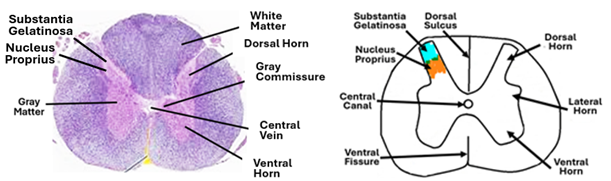
The posterior horn of the gray matter consists mainly of interneurons and tract cells. The processes of these interneurons remain within the spinal cord, whereas axons of tract cells gather into long ascending sensory pathways. The posterior horn contains two prominent parts; these are: the substantia gelatinosa and the nucleus proprium, which makes up the body of the posterior horn.
Substantia Gelatinosa
Substantia gelatinosa is a distinctive region of the posterior horn and is present at all spinal levels. In myelin-stained histological preparations, this region appears pale compared to the rest of the grey matter. It contains unmyelinated and mildly myelinated sensory fibers that carry pain and temperature receptor information. Lassauer's Tract or the dorsolateral fasciculus is a relatively pale staining area between the substantia gelatinosa and the surface of the spinal cord. It is traversed by axons of the pseudounipolar neurons of the dorsal root ganglion.
Body of the Posterior Horn
The body of the posterior (dorsal) horn of the spinal cord is called the nucleus proprius. It consists mainly of interneurons that transmit different types of somatic and visceral sensory information.
Anterior Horn of Gray Matter
The anterior horn also known as the ventral horn is broader and larger than the posterior horn. It contains large cell bodies of the Golgi type-1 lower motor neurons (α-motor neurons). Axons of these neurons constitute the anterior (ventral) rootlets which are somatic efferent nerve fibers. Lower motor neurons (α-motor neurons) are the only means whereby the nervous system can exercise control over body movements, whether voluntary or involuntary.
Destruction of α-motor neurons supplying a muscle, or interruption of their axons, causes complete paralysis of that muscle. Lower motor neurons (α-motor neurons) are present in groups known as nuclei. Nuclei of the anterior horn are separated from one another by areas containing interneurons. Smaller γ (gamma) motor neurons are interspersed with α-motor neurons; they innervate the intrafusal muscle fibers of muscle spindles. Renshaw cells, which are inhibitory interneurons, are also present in the anterior horn. In the cervical and lumbar regions, which contain the limb motor neurons, the anterior horns are enlarged laterally.
Intermediate Gray Matter
This is the region that lies in-betweens the anterior and posterior horns. It contains the spinal preganglionic autonomic nerve cell bodies. At certain levels it includes a distinctive region called the dorsal nucleus (of Clarke). These preganglionic efferent sympathetic nerve cell bodies lie in a column of cells extending from T1 through to L2 or L3. They constitute the lateral horn of the spinal gray matter.

The White Matter
The White Matter of the spinal cord is made of nerve fibers, neuroglial cells and blood vessel. The majority of nerve fibers are myelinated. Myelin is responsible for the whitish colour of the fresh white matter. Myelin dissolves in tissue processing reagents and is lost leaving empty spaces around nerve fibers - which appear as red dots in cross section; for this reason, the white matter often appears foamy in routine histological sections.
Nerve fibers within the spinal cord are functionally arranged into ascending (sensory) tracts and descending (motor) tracts. On each side of the cord, the white matter is divided into three columns or funiculi. The dorsal ascending funiculus (column) lies between dorsal horn of the gray matter and the dorsal sulcus; the lateral funiculus (column) lies between dorsal and ventral horns of the same side; the ventral funiculus (column) lies between ventral horn and ventral fissure.
In the cervical region each dorsal funiculus (column) is divided into two fascicles called the fasciculus gracilis and the fasciculus cuneatus. As more and more fibers enter the spinal cord, the thickness of the white matter progressively increases in a caudo-cranial direction.

Meninges
The CNS is invested by protective coverings collectively known as the meninges. The meninges are arranged in three layers called the dura mater, the arachnoid mater and pia mater; the latter two are together referred to as the leptomeninges. The dura mater is a tough protective dense fibrous collagenous layer that is adherent to the periosteum of the bones surrounding the CNS, namely the skull and the vertebrae. The leptomeninges perform many functions and have multiple anatomical relationships. The outer or parietal layer of the arachnoid mater is made of closely adherent flat arachnoid cells that are impermeable to the CSF due to the presence of tight junctions between them. Elsewhere, arachnoid cells are attached together by desmosomes and gap junctions. The subarachnoid space is full of CSF; this space is divided into compartments by trabeculae known as the subarachnoid trabeculae. These trabeculae provide junction between the arachnoid membrane and the pia mater. In case of infections, the arachnoid cells secrete cytokines. The pia mater directly covers the surfaces of the spinal cord and the brain; it reflects from the surface of the brain and spinal cord onto the arteries and veins, separating the subarachnoid space from the brain and spinal cord. A sleeve of leptomeningeal cells accompanies the arteries into the brain and is related to the interstitial fluid drainage pathways.
The dura mater is separated from the vertebral periosteum by the epidural space that contains a loose adipose tissue.

Ganglia
Ganglia are aggregations of nerve cell bodies outside the central nervous system; similar collection within the white matter of the CNS are known as nuclei. Ganglia are of various sizes and occupy different locations close to the CNS, independent or intramural within other organs. Structurally and functionally, ganglia are of two main types: sensory craniospinal ganglia and motor autonomic ganglia.
Craniospinal Ganglia
Craniospinal ganglia are sensory ganglia associated with the origin some of the cranial nerves, and with the posterior roots of all cranial nerves. They contain aggregation of pseudounipolar neurons that have large spherical cell bodies. Pseudounipolar neurons have two processes, an axon and single dendrite. The two processes resemble each other structurally but are different functionally. The dendrite carries impulses towards the cell body (centripetal) whereas axon that impulses away from the cell body (centrifugal). Because the proximal parts of the two processes are fused, the neuron appears as though it has single process. The dendrite brings impulses from sensory nerves endings distributed all over the body to the cell body, whereas the axon transmits impulses from the cell body towards the spinal cord. Within the spinal cord the axonal ending makes synaptic junctions with dendrites of interneurons.
The craniospinal sensory ganglia are characterized by nerve cell bodies being present in groups separated by bundles of myelinated nerve fibers. The neurons have large pale spherical nuclei containing prominent nucleoli. The spherical cell body is surrounded by satellite cells arranged in a clear single layer cellular capsule. Between the nerve cell bodies nerve fibers and associated Schwann cells.

Autonomic Ganglia
Autonomic ganglia are of two types, sympathetic and parasympathetic. A clear difference between sensory and autonomic ganglia is that neurons of autonomic ganglia have preganglionic nerve endings synapsing with them. Because of this, autonomic ganglion cells are referred to as postganglionic neurons. The cell bodies of these preganglionic nerve fibers and endings are located within the CNS. The ganglionic cells are multipolar motor neurons that modulate the actions of different types of tissues such as glands and smooth muscle.
There are two types of autonomic ganglia, sympathetic ganglia and parasympathetic ganglia. Sympathetic ganglia are located close to the vertebral column, whereas parasympathetic ganglia lie near or within the organs they innervate.
Sympathetic Ganglia
Sympathetic ganglia include the paravertebral ganglia of the sympathetic chains that lie on each side of the vertebral column, and the prevertebral ganglia including the celiac and mesenteric ganglia of the abdominal cavity. Sympathetic ganglia are surround by a fibrous connective tissue capsule and are not lobulated. Preganglionic nerve fibers originating from nerve cell bodies within the spinal cord synapse with the ganglionic cells of the sympathetic chain. Axons of motor neurons of the sympathetic ganglia pass as postganglionic nerve fibers to effector tissues and cells of visceral organs. These sympathetic ganglionic neurons are multipolar neurons that are dispersed almost evenly with the ganglia, separated from each other by unmyelinated nerve fibers. The nuclei are often eccentrically located within the ganglionic cells. The cytoplasm contains Nissl bodies, small membrane-bound electron dense granules and lipofuscin granules. Satellite cells are present around the cell bodies but do no form a continuous capsule as in sensory ganglia. Schwann cells, fibroblasts, and blood vessels are also present in between the nerve cell bodies. Nerve fibers mostly unmyelinated ones are present in abundance either singly or in small bundles.

Parasympathetic Ganglia
Parasympathetic ganglia are located within or close to the organs they supply. They are usually present as small aggregations of nerves cell bodies, surrounded by a thin capsule. The parasympathetic ganglionic neurons are multipolar motor neurons but have comparatively few processes, an axon and a few dendritic processes. The nucleus is pale and contains a prominent nucleolus. The cytoplasm contains rER (Nissl bodies) and mitochondria but is devoid of electron dense vesicle. They have synaptic junctions with preganglionic nerve endings.

Nerves
Nerves are large groups of nerve fibers; They usually contain myelinated and unmyelinated nerve fibers, as well as sensory and motor nerve fibers. The entire nerve is wrapped by a dense irregular collagenous connective tissue investment called the epineurium. The capsule is made of type-1 collagen fibers, reticular fibers, fibroblasts and other resident connective tissue cells in addition the ground substance. There no septa emerging from epineurium and passing into the substance of the nerve. A huge amount of nerve fibers is contained within the nerve. They are arranged in groups known as nerve fascicles. Each fascicle is surrounded by a perineurium made of epithelioid perineural cells. Perineural cells are arranged in layers, ranging from 2 to 15 layers. Few collagen and elastic fibers may be present between the perineural cell layers. The perineural cells are possibly of neural crest origin. They are slender cells surrounded a basal lamina and have overlapping ends. and are interconnected by tight junctions, gap junctions and zonula adherens. It is apparent then that the perineurium constitutes a strong protective barrier around the nerve fibers.
Within the fascicle individual nerve fibers are embedded in a loose connective called the endoneurium. The endoneurium contains a few collagen fibers, fibroblasts and a ground substance which hold large amounts of a fluid called the endoneuria fluid. The nerve fibers within the fascicle could by myelinated or unmyelinated. Myelinated nerve fibers a surrounded by an insulating myelin sheath made of concentric layers of the cell membrane of Schwann cells. Unmyelinated nerve fibers have no myelin sheath but still are embedded within Schwann cells. They are smaller than myelinated fibers and conduct impulses at a slower speed.
The endoneurium contains blood capillaries and arterioles derived from the larger blood vessels present in the epineurium. Branches from the epineural vessels pass across the perineurium into the endoneurium

Nerve Endings
Nerve endings are the terminations of nerve fibers that are either efferent “motor” or afferent “sensory”. Efferent nerve fibers are axons that carry impulses centrifugally (away from the nerve cell bodies in the CNS, whereas afferent fibers are dendrites that carry impulses towards the CNS. Nerve fibers whether efferent (axons) or afferent (dendrites) terminate as nerve endings. Endings of efferent nerve fibers are called efferent or motor nerve endings, whereas endings of afferent nerve fibers are called afferent or sensory nerve endings
Afferent Nerve Endings
Afferent or sensory nerve endings are characterized by numerous mitochondria that supply energy required for impulse generation. They could be free or encapsulated. Free afferent endings are distributed throughout the body e.g. in the skin, muscles, bone, tendons, visceral organs. They are terminal nerve branches that could be simple such as those involved in sensation of pain or nerve twigs associated with Merkel cells of the skin that sense touch.
Free Sensory Nerve Endings
Free sensory nerve endings are simple receptors often present within epithelia and connective tissues; they are small terminal branches of afferent nerve fibers. They are the most common type of sensory endings in the skin, where they function as receptors for touch, pain and temperature. Some of the free endings are associated with specialized cells such as Merkel cells and are present in the epidermis of the skin. They are touch receptors.

Encapsulated Sensory Nerve Endings
Encapsulated endings differ from free endings in that they are surrounded by a fibrous capsule. The capsule is of varying thickness and is continuous with the endoneurium. Encapsulated endings are mechanoreceptors that sense touch, pressure and stretch; they include:
Ruffini’s corpuscles which are mechanoreceptors; they are also thought to detect warmth, i.e. they are thermoreceptors.
Krause endbulbs are mechanoreceptors that can also detect cold. They are present in the skin, mucosae, conjunctiva, cornea and endocardium.
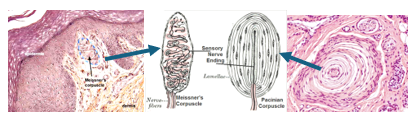
Meissner's corpuscles are present in dermal papillae of thick skin and are more common in soles of the feet; they are touch receptors.
Pacinian corpuscles are the largest and most complex of the encapsulated receptors. They are present in both superficial and deep location in different parts of the body; they sense pressure

Classification of Receptors
Sensory receptors enable the body to detect variation within the internal and external environment. The eyes, ears, nose, taste buds, and skin are all sensory organs containing sensory receptors that allow us to see, hear, smell, taste, touch, and maintain balance. Based on their location, receptors classified into cutaneous, visceral, arterial …etc. Based on type of the stimulus they respond they are classified into:
· Mechanoreceptors (mechanical receivers)
· Chemoreceptors (chemical receivers)
· Photoreceptors (light receivers)
· Thermoreceptors (heat receivers)
· Nociceptors (pain or injury receivers)
· Baroreceptors (pressure receivers)
The following table summarizes receptor types, the stimuli they respond to, examples, and the stimuli they respond to.

Mechanoreceptors
Mechanoreceptors respond to mechanical pushing and pulling by touch, pressure, gravity, stretch, and movement. As their membrane contour changes, mechanoreceptor endings fire and generate impulses that provide information to the brain about shape, texture, weight, and the landscape of objects in the external environment. Through the use of mechanoreceptors people can feel, maintain balance, and hear. Cutaneous feeling occurs when mechanoreceptors detect touch and pressure as objects come in contact with the skin. Another kind of mechanoreceptor are proprioceptors which are responsible for detection of position of our bodies. Proprioceptors are located within muscles, tendons, and joints.
Meissner's Corpuscle and Pacinian Corpuscle
These are encapsulated touch and pressure receptors. Meissner’s corpuscles are small (<1um) touch receptors found in the dermis, especially in the fingertips, lips, eyelids, nipple, genitalia. Pacinian corpuscles are large (about 1 mm) encapsulated pressure receptors present in the deep layers of skin, joint capsules and ligaments. They are the largest of encapsulated receptors having thick capsules made of large numbers of lamellae surrounding an afferent nerve ending.
The Muscle Spindle
Muscle spindle is a fusiform mechanoreceptor that consists of a group of small skeletal muscle fibers surrounded by a connective tissue capsule. The muscle fibers within the spindle are known as the intrafusal muscle fibers. There are of two types of intrafusal muscle fibers: the nuclear bag fibers which have an expanded central part containing nuclei arranged as an aggregation, and the nuclear chain fibers which are slender, uniformly cylindrical and contain nuclei arranged in a row. Intrafusal muscle fibers have sensory mechanoreceptor endings associated with them either surrounding them spirally as in the nuclear bag fibers or in associated with them in a flower spray fashion as in the nuclear chain fibers.

Chemoreceptors
Chemoreceptors are nerve endings or nerve ending and associated structures that respond to chemical stimuli. They include taste buds, olfactory cells. carotid bodies and the aortic bodies. Taste buds are located in the epithelium of the oral cavity; they have associated receptor cells that help in discriminating between sweet, sour, salty and bitter tastes. When the chemical substances dissolved in the saliva break down into molecules, they activate a signal transduction process. The transduction process depolarizes receptor potential of the ending synapsing with the taste receptor cell. Olfactory cells are modified bipolar neurons present in the epithelial lining the roof of the nasal cavity; they sense different odors. Receptor molecules of these cells bind with compounds dissolved in the mucus and generate an impulse that is carried along their axons to the olfactory cortex, where they are interpreted.
Arterial Chemoreceptors
The carotid and aortic bodies are arterial chemoreceptors present respectively in the wall of the internal carotid artery and the aortic arch; they respond to changes in blood CO2 tension. They are small bodies surrounded by a capsule and contain two types of cells, along with sensory nerve ending and fenestrated capillaries. The cell is of two types: type-1 and type-2 cells. Type-1 cells are receptor cells that make synaptic junctions with the sensory nerve endings. They sense CO2 tension in arterial blood of the capillaries and accordingly modulate the activity of sensory nerve ending. Type-1 cells are characterized by catecholamine-containing electron dense vesicles. Type-2 cells also known as the sustentacular cells provide support and insulation to the sensory nerve ending.

Photoreceptors
These are complex receptors present in the eye and will be discussed in the next chapter.
Efferent Nerve Endings
Terminations of efferent nerve fibers (axons) are called efferent or motor nerve endings. They terminate on effector cells such as muscle fibers and glandular epithelial cells making synaptic junctions with them. The efferent nerve endings are presynaptic to effector cells. They are characterized by the numerous neurotransmitters containing vesicles. The vesicles could be clear vesicles containing acetylcholine as in cholinergic efferent endings, or dense-cored vesicles containing norepinephrine, serotonin and other amines as in efferent aminergic endings. The motor endplate is a clear example of cholinergic ending, where the efferent ending is packed with clear vesicles.
Efferent nerve fibers end on muscle fibers forming motor endplates. Each nerve fiber gives a number of branches that end on individual muscle fibers. The nerve endings (the endplates) are clearly enlarged. Each muscle fiber has a motor innervation of its own, where an efferent nerve fiber enlarges forming a motor endplate. The endplate contains numerous acetylcholine containing clear vesicles and few mitochondria. The sarcoplasm at the neuromuscular junction shows synaptic clefts. The pre- and postsynaptic membranes are thickened and can easily identified by electron microscope. The presynaptic membrane is thicker than ordinary cell membrane and has synaptic vesicles attached to it; the post-synaptic membrane is even thicker than the presynaptic membrane

Synapses
Neurons communicate with each other via synapses. Synaptic junctions within the CNS are complex, a single neuron may synapse with hundreds of other neurons. Usually, terminations of axons of a neuron synapse with dendrites of other neurons; this is called axo-dendritic synapse; they may also synapse with cell bodies of other neurons, and this type of synapses is called axo-somatic synapse. Less frequently axons may synapse with other axons, and this known as axo-axonic synapses. Synapses may be excitatory or inhibitory or reciprocal. Synapses are specialized regions of the cell membrane where neurotransmitters are released. Synapses have three components: a presynaptic membrane, a synaptic cleft and a post-synaptic membrane. The presynaptic axonal ending contains numerous neurotransmitters containing vesicles. The cell membranes of synapsing axonal and dendritic process are thickened. The postsynaptic membrane is thicker than the pre-synaptic membrane; numerous vesicles containing the transmitter are associated with the presynaptic membrane. These vesicles are often referred to as synaptic vesicle. They release their content of neurotransmitters by exocytosis into the synaptic cleft to excite or inhibit the post synaptic neuron or effector cell.


Comments