
Urinary Tissue
The urinary system is a multiorgan system, its primary function being production, transportation, storage, and elimination of urine to maintain homeostasis by regulating the water and ionic balance of the blood. It has several specific functions which include removal waste products metabolism and ingested harmful substances and medicines. balancing the body fluids, balance of electrolyte, secretion of hormones that participate in the control blood pressure, production of erythropoietin that control production of red blood cells, participation in the control pf calcium and phosphorus. The system carries on most of its functions by filtering blood and creating urine as a waste by-product. The urinary system carries on its tasks by a number of organs, which include the kidneys, renal pelvis, ureters, bladder and urethra.
The Kidney
There are two kidneys in the body; they a pair of bean-shaped vital organs that remove waste and excess water from the body. Most of the urinary system functions are carried out by the kidneys. The kidneys have several functions which include:
1. Removal of waste products from the body.
2. Removal of drug metabolites from the body.
3. Balance of the body's fluids.
4. Release of hormones that regulate blood pressure.
5. Production an active form of vitamin D that maintains bone health.
6. Control of production of red blood cells in hemopoietic organs.
The kidney is of mesodermal origin. Its development starts with appearance of the pronephros, then the mesonephros, then the metanephros. Histologically it consists of two types of tissues, epithelial tissue and connective tissue. The epithelial tissue is supported by connective tissues. The supportive connective tissues are collectively referred to as the renal stroma, whereas the epithelial elements are collectively referred to as the renal parenchyma. The parenchymal element form uriniferous tubules which have two components; uriniferous tubules and nephrons. Another important component of the kidney is the renal vasculature. Parts of the epithelial elements of the kidney are confined to the outer parts of the kidney constituting what is known as the renal cortex; other elements are confined to the inner parts of the kidney forming the renal medulla. Most of the kidney functions particularly the filtration of blood, reabsorption of useful elements, urine formation and control of the acid-base balance are carried out by the parenchymal elements in conjunction with the renal vascular elements.

The Renal Stroma
The renal stroma is the connective tissue component of the kidney; it comprises the capsule and interstitium. The renal capsule is thin dense fibrous connective tissue capsule rich in collagen type1 fibers. There are no septa that emerge from the capsule into the substance of the adult kidney and thus the adult kidney is not lobulated. The capsule is surrounded by the perinephric fat which is protective.
The renal interstitium is a sparse loose connective tissue present between the parenchymal elements and around the vascular elements of the kidney. It is defined as is defined as connective tissue occupying the intertubular, extraglomerular, extravascular space of the kidney. It is inconspicuous in the renal cortex and more easily seen in the renal medulla, particularly around the collecting tubules. The interstitium is not a passive space in which the functional units (the nephrons) are embedded. On the contrary, it mediates and modulates exchange between the tubular and vascular elements of the kidney. Some of the peritubular interstitial cells are secretory; they secrete prostaglandin, prostacyclin and erythropoietin and renin. Collagenous connective tissue is associated with large blood vessels. Like loose connective tissues elsewhere, it has ground substance, fibers and cells. The ground substance contains glycoproteins and proteoglycans including glycosaminoglycans, the cells include fibroblasts, macrophages, lipocytes, pericytes and peritubular cells. The peritubular cells of the renal cortex synthesize and secrete erythropoietin, the juxtaglomerular produce renin. The interstitium contains collagen type I and type 3 (reticular) fibers.
Uriniferous Tubules
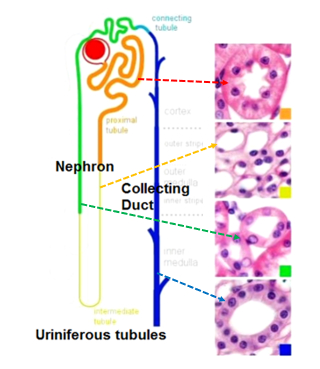
The renal parenchyma is made of epithelial cells that are arranged into tubular structures known as uriniferous tubule. Each uriniferous tubules consists of a nephron and a connecting tubule that drains into a collecting duct. The walls of the different parts of the uriniferous tubules made of simple epithelia ranging simple squamous to simple cuboidal or to simple columnar. The kidney is fully packed uriniferous tubules.
The Renal Cortex
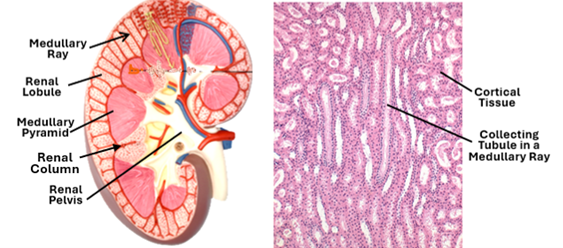
The renal cortex is outer part of the kidney that lies under the capsule. It surrounds the medulla. It appears granular under the microscope because it contains many spherical structures. These spherical structure are called the renal. In addition to the renal corpuscles, the cortex contains numerous convoluted tubules, named as proximal convoluted tubules and distal convoluted tubules. The cortex appears darker than the medulla due to the presence of large numbers of proximal convoluted tubules that have dark thick walls.

The Renal Medulla
The medulla surrounds the renal pelvis and its calyces and is surrounded by the cortex. It appears pale and striated under the microscope due to presence of numerous straight collecting tubules converging towards the calyces and also due to the presence of many straight blood vessels known as vasa recta. The medulla also contains parts of the loops of Henle

Medullary Pyramids
Medullary pyramids are cone-shaped structure present in the renal medulla. They are also known as renal pyramids and Malpighian pyramids. There are eight pyramids in the human kidney. The medullary pyramids are separated from each other by cortical tissue extensions known as the renal columns of Bertin. The tips of the pyramids are called the renal papillae; they point toward the renal pelvis. Each medullary pyramid and the cortical tissue overlying it constitute a renal lobe. The renal lobule is divided into ill-defined renal lobules, which are cortical lobules. The cortex contains bundles of straight collecting tubules known as the medullary rays, which traverse the cortex and pass towards the medullary pyramids. These medullary rays divide the cortex into indistinct lobules; a renal lobule being the cortical tissue between two medullary rays.
The Nephron
The nephron is the structural and functional unit of the kidney. It filters blood, perform reabsorption of useful substances and secretion, and as well maintains the acid-base balance of body. There are 0.5-1.5 million nephrons in the kidney. Nephrons are of two different types; they could be cortical being confined to the cortex or juxtamedullary being (partially cortical and partially medullary.
The nephron has two main structural and functional parts, the renal corpuscle and the renal tubule. The renal is also known as Malpighian corpuscle; it consists of Bowman’s capsule and the glomerulus. The renal tubule is about 55mm in length and comprises the proximal convoluted tubule, loop of Henle and distal convoluted tubule.

Bowman’s Capsule
Bowman’s capsule is the first part of the nephron. It is a cup-shaped structure that has two poles, a vascular pole and a tubular pole. The tubular pole is also known as the uriniferous pole or urinary pole. Bowman’s capsule consists of two layers, a parietal layer, and visceral layer and a space in between the two layers. The parietal layer is made of a single layer of flat cells i.e. it is a simple squamous epithelium. The visceral layer consists of a single layer of modified squamous cells that possess feet processes; these modified cells are caked podocytes. The space between the parietal and visceral layers of Bowman’s capsule is known as Bowman’s space. Filtration barrier, filtration slits, mesangial cells and Lacis cells are associated with Bowman’s capsule but will be discussed later.

The Glomerulus
The glomerulus is a tuft or coiled network of capillaries surrounded by Bowman’s capsule. It is a unique capillary bed located between two arterioles, an afferent and an efferent instead of being between an arteriole and a venule. Moreover, the efferent is smaller than the afferent arteriole, and this leads to a high capillary blood pressure that facilitate more efficient blood filtration. The capillary wall is fenestrated endothelium, that is simple squamous epithelium with holes in it. The endothelium is covered by podocytes, which are the modified cells of the visceral layer of Bowman’s capsule, which is a simple squamous epithelium consisting of flat cells with processes.

Glomerular Filtration Barrier
The glomerular filtration barrier is a barrier consisting of those structures that intervene between lumen of glomerular capillaries and Bowman’s space; they include the capillary endothelium, glomerular basement membrane and podocytes. All of these structures are clearly visible under the electron microscope, but difficult to see with the light microscope. The endothelium is fenestrated and thus allows passage blood components but prevents passage of macromolecules and formed elements of blood. It allows passage of water, solutes, and other small molecules.
The glomerular basement membrane is the fused basal laminae of the glomerular capillary endothelium and the podocytes. The glomerular basement membrane has three layers internal laminae rara, the external lamina rara the lamina densa sandwiched between the two laminae rara. The glomerular basement membrane restricts passage of proteins >70.000 Daltons. Podocytes have filtration slits interposed between their secondary processes. The slits have membranes that prevent free diffusion.

Proximal Convoluted Tubule
The proximal convoluted tubule is the first and longest part of the renal tubule; it is highly convoluted. It is confined to the cortex. It reabsorbs about 65% of water and ions of the glomerular filtrate. It has a simple cuboidal epithelium. Epithelial cells have deep eosinophilic cytoplasm and prominent nuclei. The cell boundaries are indistinct. The epithelium has an apical striated border made of microvilli; the striated border appears evident in PAS-stained sections. It is PAS+.
Electron microscopy shows that epithelial cells of the proximal convoluted tubule possess numerous apical microvilli. These microvilli greatly increase the surface area available reabsorption of the glomerular filtrate. The basal surface of the cells of the proximal tubule has numerous basal cell membrane infoldings associated with numerous mitochondria. This arrangement is necessary for efficient active transport of Na+ against a concentration gradient; this is a Na+ pump.

Loop of Henle
The loop of Henle consists of a descending limb and an ascending limb. It has thick and thin segments. The thick segment of the descending limb is called the pars recta of proximal convoluted tubule and has the same histological features as the proximal tubule. The thin segment of the descending and ascending limbs has a wall made of simple squamous epithelium. It dips into the medulla surrounded by vasa recta. The thick segment of the ascending limb resembles the distal convoluted tubule and is known as its straight part or pars recta of the distal convoluted tubule.
Distal Convoluted Tubule
DCT is shorter and less convoluted than PCT. It is also confined to the cortex. It has a simple cuboidal epithelium and wide lumen. It appears paler than PCT and has no prominent striated border. It functions in aldosterone-controlled Na+ absorption. The first part of DCT lodged between the afferent and efferent arterioles at the vascular pole of Bowman’s capsule is modified. Its cells become columnar forming the macula densa, which is part of the juxtaglomerular apparatus.

Juxtaglomerular Apparatus
As the distal convoluted tubule approaches the renal corpuscle it comes in contact with the afferent arteriole supplying the renal glomerulus. At this point of contact, both the afferent arteriole and distal convoluted tubule are modified. Smooth muscle cells of the afferent arteriole assume an epithelioid and become known as the juxtaglomerular cells. They secrete renin. The modified cells of the distal convoluted tubule are narrower than the rest, their nuclei are closer to each other and the area appears denser and is referred to the macula densa. Macula densa cells are osmoreceptors or chemoreceptors that detect changes in Na+ concentration. The juxtaglomerular cells and macula densa cells together constitute the juxtaglomerular apparatus. The juxtaglomerular apparatus participates in maintaining blood pressure and blood volume by the production of the hormone renin.

Collecting Tubules and Ducts
Collecting tubules include the arched collecting tubules in the cortex, straight collecting tubules in the medullary rays and larger collecting tubules in the medulla. In all of them the epithelium is pale simple cuboidal. The largest tubules in the medullary papillae are called the papillary ducts or ducts of Bellini; they are lined by simple columnar epithelium. The larger collecting tubules and ducts are lined by simple cuboidal epithelium. The epithelium contains two types of cells: pale cells called the principal cells and darker ones known as intercalated cells. Water reabsorption is their main function and thus they participate in electrolyte and fluid balance. Collecting tubules concentrate urine; they passively reabsorb water following the osmotic gradient created by the counter current multiplier system. Moreover, the principal epithelial cells perform ADH-dependent water reabsorption and active reabsorption of Na+. Intercalated cells contain many mitochondria; they secrete H+ and reabsorb HCO3 and thus participate in maintaining the acid/base balance.
Collecting ducts are made of a simple high cuboidal epithelium, which gradually change into a simple columnar epithelium. The largest of ducts made of a simple columnar epithelium are known as the ducts of Bellini which traverse towards the renal papillae to open on the renal pelvis. Close to their terminations the simple columnar epithelium changes into a stratified columnar before merging in the stratified transitional epithelium of the calyces.

The Renal Interstitium
The renal interstitium is the sparse loose connective tissue that occupies the spaces between the parenchymal elements of the kidney. It presents around the renal corpuscles, between the convoluted tubules of the cortex, between the straight tubules in the cortex and medulla and between the large ducts of the medulla. It is meager and inconspicuous in the cortex and more abundant and evident in the medulla. It is particularly evident around the collecting tubules in sections stained by special techniques such Masson’s trichrome staining method, and much less evident in H&E-stained sections. Some of the peritubular interstitial cells are secretory; they secrete bioactive molecules including prostaglandin, prostacyclin and erythropoietin. Erythropoietin produced by the renal interstitial cells are the primary regulator of erythropoiesis. It acts on bone marrow erythroid progenitor cells and stimulates them to differentiate into erythroblast, normoblasts, reticulocytes and mature RBCs. The interstitial secretory cells are difficult to identify in routine H&E-stained histological section but can be identified by immunohistochemical methods using specific antibodies e.g. anti-erythropoietin antibody. The interstitium also contains ordinary components of loose connective tissue including fibroblasts, macrophages, collagen type1 and type3 fibers and glycoproteins of the ground substance.

Renal Microvasculature
The renal artery as it enters the kidney divides into segmental arteries which break down into lobar arteries; lobar arteries give rise to interlobar arteries that course upwards in between the medullary pyramids. At the base of pyramids, the interlobar arteries bend to run parallel to the bases of pyramids forming arcuate arteries. Interlobular arteries emerge from the arcuate arteries and pass into the cortex between the renal lobules giving afferent arterioles that supply the glomeruli. Efferent arterioles that drain the glomeruli break into another set of capillaries abutting upon the nephron tubules, forming peritubular capillaries. The peritubular capillaries drain into interlobular veins which drain into arcuate vein. The efferent arterioles also give rise to straight vessels that traverse the medulla forming the vasa recta, which play a significant role in urine concentration via the counter current exchanger system.

The Ureter
The ureter is a tubular structure that conducts urine from the kidney to the urinary bladder. It is a continuation of the renal pelvis and has an epithelium that resembles the pelvic epithelium. The wall of the ureter consists of a mucosa, muscularis and adventitia. The mucosa consists of the epithelium and the underlying connective tissue lamina propria; there is no muscularis mucosa, yet the deeper part of the lamina propria is occasionally referred to as the submucosa.
Urothelium
The renal pelvis, the urinary bladder and parts of the urethra are lined by a stratified transitional epithelium. This type of epithelium has unique features and is found only in the urinary system and accordingly is called urothelium. The urothelium is a stratified epithelium comprising of 3-7 layers of pale cells with clear boundaries. It has the unique feature of having the ability to change shape. Urothelial cells change shape their shapes in response to pressure or distension forces exerted on them. For instance, when urine presses on the urothelium the epithelial cells become shorter and the epithelium assume a flattened appearance. The superficial (innermost) layer of the urothelium contains unique cells known as umbrella cells, which are multinucleated cells with a vacuolated cytoplasm and convex scalloped apices. They can be demonstrated immunohistochemically by the use of anit-uroplakin antibodies. Umbrella cells augment the barrier function of urothelium by preventing passage of pathogens and toxic substances from urine into underlying epithelial cels other tissues


The Lamina Propria, Muscularis and Adventitia of the Ureter
The lamina propria is a typical loose connective tissue; it often shows bundles of collagenous fibers. The lamina propria frequently contains diffuse lymphoid tissue or occasional solitary nodules. The tunica muscularis consists of two layers of smooth muscle; inner one forms a wide spiral whereas outer one forms a tight spiral layer. The inner wide spiral layer appears longitudinal in histological sections whereas the outer tight spiral layer appears circular. A third outer longitudinal layer is present in distal part of the ureter. Blood vessels and nerves supply the other layers are present in the adventitia.
Urinary Bladder
The urinary Bladder is histologically similar to lower parts of ureter except for its wider lumen and thicker wall. It has the same tissue layers as the ureter i.e. mucosa, muscularis, and serosa / adventitia. The lining epithelium is a typical urothelium. The tunica muscularis of the bladder is subdivided into three layers of smooth muscle: inner longitudinal, middle circular, and outer longitudinal. Outermost layer is adventitia except for its superior surface which is covered by serosa “peritoneum”. Around the serosa/adventitia covering of the bladder is a layer of perivesical fat.
The intramural ureters pierce the bladder wall obliquely; bladder wall pressure and a mucosal fold extending over the ureteral orifice prevent backflow of urine into the ureter. At the urethral orifice circular muscle layer forms the internal sphincter of the bladder.

Urethra
The urethral lumen is narrow and is kept closed except during passage of urine or semen in males. The proximal part of the urethra in both sexes is transitional epithelium, and the distal part is stratified squamous epithelium, in between the epithelium is pseudostratified. In males, the prostatic urethra is lined by transitional epithelium, the membranous is lined by pseudostratified, whereas the penile urethra is lined by stratified columnar and stratified squamous epithelium. In both sexes, beneath the urothelium is the lamina propria which is a loose connective tissue that contains many elastic fibers and smooth muscle fibers. In the penile urethra, the lamina propria contain small mucous glands known as the glands of Littre. The lamina propria of the penile urethra is surrounded by an erectile tissue made of a network of venous sinuses known as the corpus spongiosum (corpus cavernosum urethra); this allows easy passage of the ejaculate out of an erect penis.
The female urethra also is lined by urothelium, pseudostratified, and stratified squamous epithelium. The underlying lamina propria contains urethral gland composed of mucous acini. These glands are known as Skene’s glands; they accumulate colloid or concretions. Skene’s glands secrete a viscid fluid during sexual arousal, which helps with lubrication. In some individuals, Skene’s glands may pass out their secretion in a way similar to ejaculation producing a viscid substance during orgasm. The lamina propria contains a network of venous plexuses similar to male corpus spongiosum; followed by inner longitudinal and outer circular smooth muscle. There is an outer skeletal muscle layer that forms a sphincter


Comments