
Male Genital Tissue
This is also known as male reproductive system. It consists of the consists of the testis, the epididymis, the vas deference, the seminal vesicle, the prostate, Cowper’s gland, the urethra and penis. Its main functions are production, maintenance, and transportation of spermatozoa (the gametes), and production of a fluids (seminal fluid) that carries and protects the spermatozoa, and the ejection of sperms at the end of a sexual relation. Moreover, the male reproductive system produces and secretes testosterone which is the male sex hormones responsible for maintaining the male reproductive system. Testosterone is responsible for the primary sexual development, which includes testicular descent, spermatogenesis, enlargement of the penis and testes. Testosterone has many other roles that include eliciting sex drive (libido), building muscle mass and strength, and maintaining bone density. Testosterone is also involved in regulating secondary male characteristics, which include male hair patterns, vocal changes, and voice deepening. Testosterone has anabolic effects; it stimulates protein synthesis, which causes growth of skeletal muscle. Testosterone also stimulates erythropoiesis, which results in a higher hematocrit in males versus females. Testosterone levels tend to drop with age; because of this, men tend to experience a decrease in testicular size, a drop in libido, lower bone density, muscle mass decline, increased fat production, and decreased erythropoiesis, leading to possible anemia.
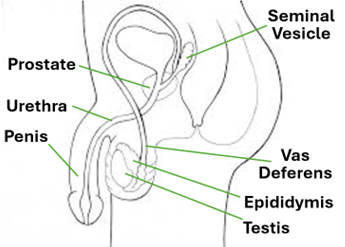
The Testis
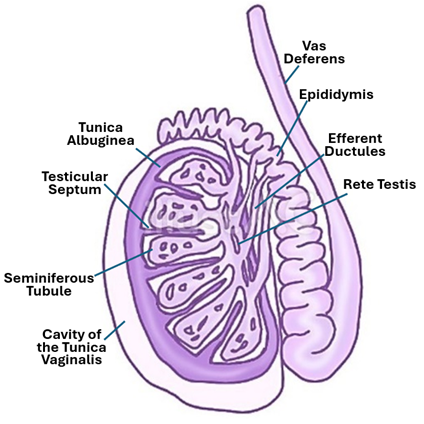
The testes (two in number) lie within the scrotum. Each testis (testicle) is an ovoid organ (gland) surrounded by a thick capsule known as the tunica albuginea. The posterior part of the tunica albuginea is thickened to form mediastinum testis. Thin inconspicuous fibrous septa radiate from the mediastinum testis dividing the testis into lobules. Each lobule contains seminiferous tubules (1-4), loose connective tissue (interstitium), interstitial Leydig cells, vessels and nerves.
Testicular Parenchyma and Interstitium
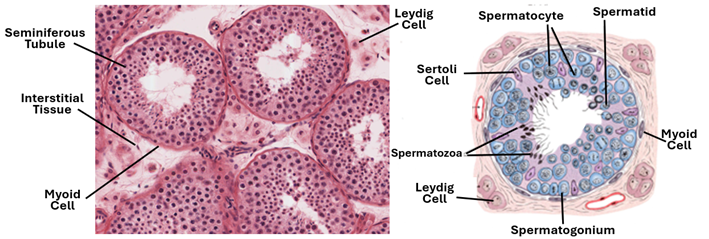
The substance of the testis consists of a parenchyma and an interstitium surrounded by a tough fibrous tunica albuginea. The testicular parenchyma consists of epithelial cells constituting seminiferous tubules and Leydig cells. Testicular interstitium is made of the loose CT present between the seminiferous tubules. It is made of collagen type1 fibers, reticular fibers, elastic fibers, fibroblasts, mesenchymal cells, macrophages and few mast cells. It contains blood vessels, lymph vessels and nerves, as well as the interstitial endocrine cells known as Leydig. Cells. It also contains myofibroblasts that encircle the seminiferous tubules; these myofibroblast are occasionally arranged in layers. The testis interstitium plays a major role in the normal functioning of the testis; it provides mechanical support to the seminiferous tubules and blood vessels, produces testosterone by its interstitial cells of Leydig cells, and augment the blood-testis barrier made by Sertoli cells.
Leydig Cells
These cells are also known as interstitial cells of the testis. They are the most conspicuous feature of the testicular interstitium; They are PAS+ cells. Leydig cells are hormone producing cells; they secrete the male sex hormone testosterone. They contain organelles necessary for steroid hormone (testosterone) synthesis and secretion, which include sER, well-developed Golgi and secretory vesicles. In older people they contain characteristic cytoplasmic inclusions known crystals of Reinke. These are rod shaped structures, usually arranged in a linear pattern; they are of unknown functions, but could be a by-product of testosterone production.
Seminiferous Tubules
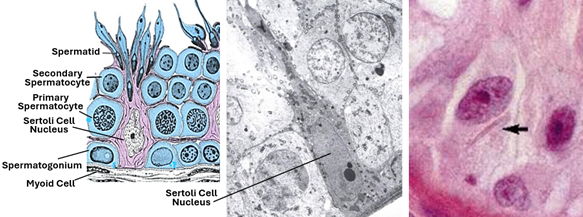
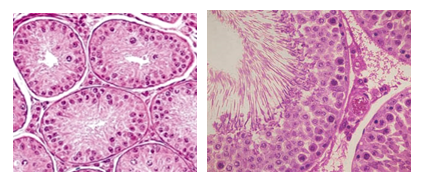
Each testis contains about 500 seminiferous tubules. Seminiferous tubules are blind-ended slender tortuous hollow cylindrical structures. Before puberty the tubular lumen is wide, seminiferous epithelium is thin and consists of two types of cells, spermatogonia and Sertoli cells. After puberty its epithelium becomes much thicker and the lumen narrower. It becomes a complicated partially stratified epithelium containing Sertoli cells and numerous spermatogenic sex cells at different stages of development. The epithelium rests on a basal lamina, and the basal lamina is surrounded by myoid cells.
Sertoli Cells
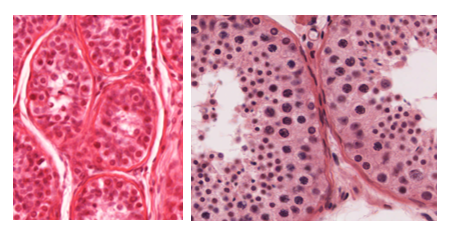
Sertoli cells are a characteristic feature of the seminiferous epithelium. They are tall transepithelial supportive cells that extend from the basal lamina to the lumen of the seminiferous tubule. They are difficult to identified because their lateral borders are irregular containing depressions that house the developing spermatogenic cells. The nucleus of Sertoli cells is pale irregular, indented and basally located. The cytoplasm contains many organelles including rER, mitochondria, Golgi, and SER, in addition to secretory granules and lipid droplets. They contain unique spindle shaped filamentous structures called Charcot–Bottcher crystals. Sertoli cells support, protect and nourish sex cells. Sertoli cells have many functions that include:
1. Nourishment of sex cells
2. Production of androgen binding protein (ABP) and inhibin
3. Formation of the blood / testis barrier
4. Phagocytosis of residual bodies
5. Secretion of the tubular fluid and regulatory factors for spermatogenesis, Leydig cells and the peritubular cells.
Gametogenesis
Gametogenesis is the process of formation of the male and female gametes (formation of the sperms and ova. Formation of the male gamete (sperm) is called spermatogenesis. Formation of the female gamete (ovum) is known as oogenesis. Spermatogenesis (sperm formation) takes place within the seminiferous tubules of the testis. Gametogenesis commences at puberty.
The Testis at Puberty
Before puberty the somniferous tubules of the testis contain only two types of cells; these are the supportive Sertoli cells and spermatogonia. At puberty the pituitary gland starts to secrete gonadotrophic hormones (ICSH, FSH, LH). ICSH (interstitial cell stimulating hormone) stimulates Leydig cells to produce testosterone, which stimulates spermatogonia to start the process of spermatogenesis. Testosterone also influences the male sex glands. Spermatogonia are unipotential stem cells that give rise to only type of functional cells. It is a unique functional cell, a haploid cell with a head and tail. Before puberty, spermatogonia are dormant regarding differentiation into functional cells. At puberty and under the influence of ICSH and testosterone, spermatogonia start to proliferate and differentiate into primary spermatocytes, secondary spermatocytes, spermatids and sperms.
Spermatogenesis
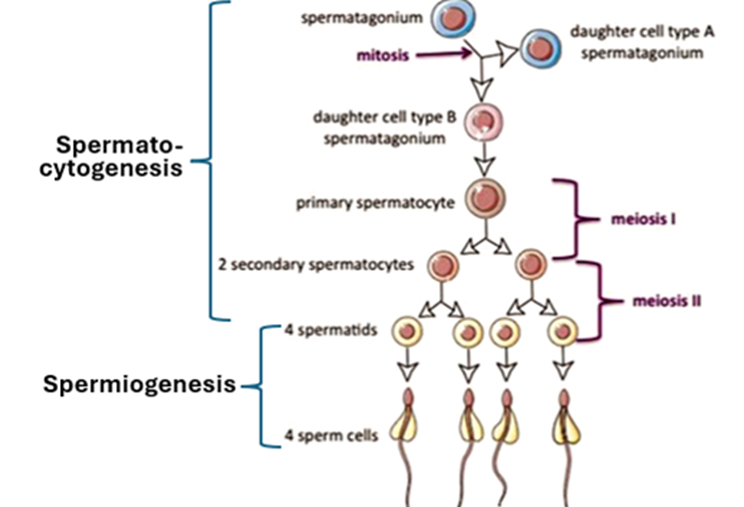
Spermatogenesis is the process whereby spermatogonia yields spermatozoa. It involves cell divisions of two different types and as well a transformation in the cell shape. The part of spermatogenesis involving cell divisions is called spermatocytogenesis, whereas the other part which involves change in cell shape without cell division is called spermiogenesis. Spermatocytogenesis results in the formation of three different types of known as the primary spermatocytes, secondary spermatocytes and spermatid.
Spermatocytogenesis
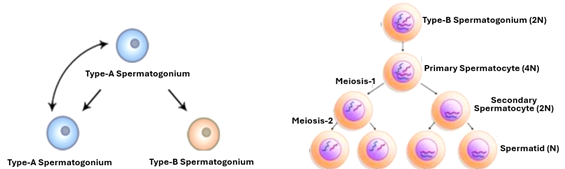
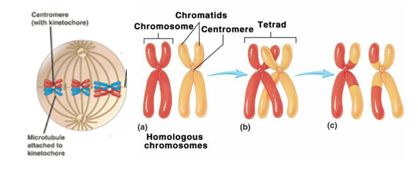
Spermatocytogenesis is the first part of spermatogenesis whereby spermatogonia give rise to primary spermatocytes, secondary spermatocytes then spermatids. It involves only cell divisions but comprises two different types of cells division, mitosis and meiosis. Mitosis is the type of cell division whereby all body cells except spermatocytes and oocytes divide. By mitosis a diploid (2N) cell divides and gives rise to two diploid (2N) cells identical to each other and to the mother cell. Any mitotic division is preceded by doubling of the cell chromosomes by synthesis of new DNA. Meiosis on the other hand, is found only in spermatocytes and oocytes of the testis and ovary. It is made of two successive cell divisions preceded which involves only one doubling of the chromosomes; there is no DNA synthesis and doubling of chromosomes between the two successive meiotic divisions. Spermatogonia proliferate by mitosis; each dividing cell gives rise to two cells genetically identical to each other. One of the two daughter cells replace mother cell remaining as type-A spermatogonium. The other daughter cell is a type-B spermatogonium; it proliferates and develops into primary spermatocytes. Primary spermatocytes enlarge, enters prophase of the first meiotic division. The prophase of the first meiotic division differs from the S-phase of the prophase of mitotic division where doubling of the amount of DNA and also the number of chromosomes takes place. At these stages the cell is tetraploid (4N). During this prophase of meiosis-1, pairing of the homologous chromosomes takes place forming chromosomal tetrads. Chiasma formation and crossing-over take place in the metaphase of meiosis-1; this helps in shuffling of genes. Non-disjunction of chromosomes can take place and lead to trisomy and monosomy. Trisomy of autosome # 21 causes Down syndrome. Sex chromosome monosomy (XO) causes Turner syndrome. The primary spermatocytes complete the first meiotic division giving rise to two secondary spermatocytes which immediately go into the second meiotic division without DNA-replication and divide into to two haploid cells, spermatids.
Tetrads, Chiasma and Crossing-over
Spermiogenesis
Spermiogenesis is the process whereby spermatids change shape without cell division. The spherical spermatid gradually changes its shape into a peculiar motile cell known as spermatozoan. The nucleus, the centrioles, rER, Golgi apparatus and mitochondria are involved in this change of shape. Hyaluronidase and acrosin are synthesized within the cisternae of rER and the transported to the Golgi apparatus where they condensed to form acrosome granules. The acrosome granules coalesce to form the acrosomal vesicle. Meanwhile the nucleus moves one pole of the cell, condenses and assumes an oval shape forming the head of the developing sperm. The acrosomal vesicle covers the anterior surface of the developing head forming the head cap or acrosomal cap. The centrioles move to opposite end the nucleus and form a flagellum or axoneme that give rise to the tail. Mitochondria arrange themselves around the axoneme between the two centrioles forming the mitochondrial sheath of the middle piece of the tail. The mitochondrial will provide energy required for tail beating during sperm motility. The microtubules arrange themselves into bundles alongside the condensed nucleus forming manchettes. The cells gets rid of the rest of cytoplasm by streaming down the manchettes. The shed off masses of cytoplasm constitute residual bodies that are phagocytosed by Sertoli cells.

Tubuli Recti
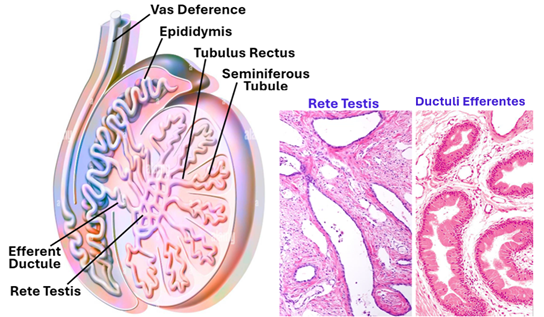
The sperms formed in the seminiferous tubules are transported towards the epididymis via the tubuli recti, rete testis and ductuli efferentes. The tubuli recti are extensions of the seminiferous tubules. The contorted seminiferous tubules abruptly transform into straight tubules (tubuli recti) lined by an epithelium made of Sertoli cells alone, instead of the seminiferous epithelium made of spermatogonia, spermatocytes and Sertoli cells. The tubuli recti transport the sperms towards the rete testis.
Rete Testis
Rete testis is a network of channels present within the mediastinum testis surrounded by a highly vascular connective tissue rich in myoid cells, which by their contractions propagate the sperms towards the epididymis. Rete channels are lined by a simple cuboidal epithelium made of cells show many microvilli and a single cilium. The microvilli increase the surface area and enhance efficiency of absorption the tubular fluid, and the cilium for percolation of the fluid,
Ductuli Efferentes
These are about 20 in number that connect the rete testis to the epididymis. Their distal ends are coiled and form part of the head of the epididymis. The epithelium of the ductuli is pseudostratified containing alternating columnar ciliated cells and cuboidal cells with microvilli; this gives the ductular epithelium a aw-teeth appearance.
The Epididymis
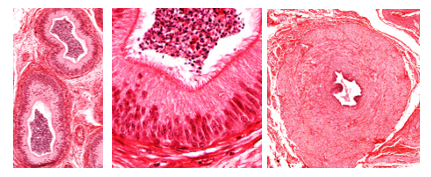
Sperms are carried from the testis to the epididymis where they are stored, awaiting ejaculation. During storage the sperms become motile; they gain ability to move. The key factors involved in this process are calcium ions (Ca2+), bicarbonate (HCO3 −), and cyclic adenosine monophosphate (cAMP). The epididymis is a very long 4-6m long highly contorted duct with a head, body and tail. The epididymal epithelium is a high pseudostratified with stereocilia. The stereocilia are tall microvilli that are mistaken for cilia when seen under the light microscope. They greatly increase the surface area of the principal columnar cells and their absorption capabilities. They efficiently renew the epididymal fluid which holds the waste products of millions of spermatozoa. The epithelium is made of two types of cells, the principal which are tall and basal cells. The epididymal epithelium is surrounded by a layer of connective tissue and smooth muscle. Its lumen is always full of sperms.
The Vas Deferens
This is a long duct that carries sperms from the epididymis towards the urethra at a high-speed during ejaculation. It has a narrow lumen and a comparatively very thick wall consisting of an pseudostratified columnar epithelium, a connective tissue lamina propria, a tunica muscularis made of smooth muscle fibers, and a connective tissue adventitia. The tunica muscularis comprises three layers, an inner longitudinal, an outer longitudinal and in between a middle layer of circularly arranged fibers. The adventitia contains large blood vessel and bundles of nerve fibers that supply the muscularis and the mucosa.
Male Sex Glands
Male sex glands include the seminal vesicles (pair), prostate and Cooper’s gland. They produce the fluid part of the semen which nourishes the sperms They are compound tubuloalveolar glands. Their normal functioning is maintained by testosterone (produced by Leydig cells in the testis). Their secretion contains fructose (sperm metabolism), vitamin C and prostaglandins.
Seminal Vesicles
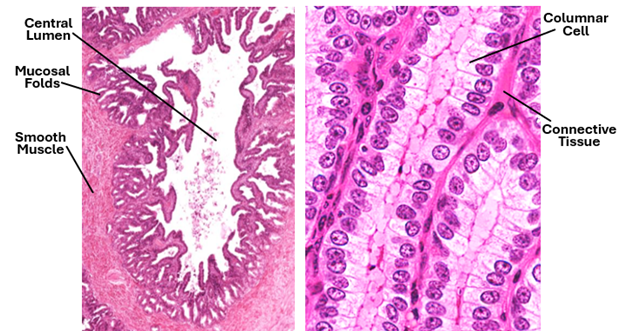
The seminal vesicles are a pair of saccule glands located posterior to the urinary bladder. Each gland has a short duct that joins with the ductus deferens at the ampulla to form an ejaculatory duct, which then empties into the urethra. The fluid from the seminal vesicles is viscous and contains fructose, which provides an energy source for the sperm; prostaglandins, which contribute to the mobility and viability of the sperm; and proteins that cause slight coagulation reactions in the semen after ejaculation. The seminal vesicles are honeycombed saccules characterized by highly convoluted folds of the mucosa, lined by a pseudostratified columnar epithelium. The epithelium is mostly simple columnar with all the nuclei basally located. The cytoplasm of columnar calls often appears pale, and the cell boundaries are clear; they secrete a mucoid substance rich in fructose. The folds join one another and open into a large, central lumen filled with a pale-staining, homogenous secretion. A smooth muscle coat surrounds the saccular glandular end-pieces. The contraction of the smooth muscle fibers of the coat expels the vesicular secretions out the gland during ejaculation.
Prostate
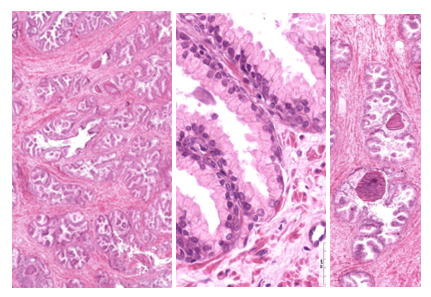
The prostate gland is located inferior to the urinary bladder. It is the largest of the accessory male sex glands, being about the size of a walnut; it encircles the urethra as it emerges from the urinary bladder. Its parenchyma comprises 30-50 tubuloalveolar glands, lined mostly by simple cuboidal and simple columnar epithelium and occasionally by a pseudostratified columnar epithelium. Secretory cells often appear pale with clear cell boundaries in between. Several short ducts arise from the parenchyma of the gland and empty into the prostatic urethra. The prostatic secretion is thin, milky colored, and alkaline; it contains prostatic enzymes such as the prostatic specific enzyme (PSA) and spermine which enhance the motility of the sperm. The prostate often contains large lamellar bodies known as corpora amylacea; these are concretions of the prostatic secretions, and they increase in number with age of the individual.
The prostate is surrounded by a collagenous connective tissue capsule that contains smooth muscle fibers and elastic fibers. Smooth muscle fibers are also present with the substance of the prostate. During ejaculation they contract and forcefully squeeze the prostatic secretions out of the prostate into the urethra. Histologically, the prostate gland is divided into three zones, the transition zone, the central zone and the peripheral zone.
The transition zone is the innermost zone which surrounds the upper parts of the urethra; it is the smallest part of the prostate constituting only about 10% the volume of the prostate. The central zone surrounds the transition zone and makes up about 25% of the volume of prostate. The peripheral zone constitutes the main bulk (about 70%) of the prostate. The transition zone tissue tends to undergo benign (non-cancerous) growth in old age.
Cowper’s Glands
These are also known as the bulbourethral glands; they are a pair of small compounds tubuloacinar exocrine glands, about the size of a pea, located near the base of the penis. A short duct emerges from each gland and enters the proximal end of the penile urethra. During sexual arousal, the bulbourethral glands secrete an alkaline mucus-like fluid, which neutralizes the acidity of the urine residue in the urethra, helps to neutralize the acidity of the vagina, and provides some lubrication for the tip of the penis during intercourse.
A bulbourethral gland is typically made of tubules and acini, which is why we can characterize it as a tubulo-acinar or tubulo-alveolar gland. Each gland is formed of a number of lobules that are enclosed within a fibrous capsule. Within these lobules, mucous acini are lined by simple columnar or pseudostratified epithelium. A thin layer of myoepithelial cells surrounds each separate acinus. The acini open into intralobular ducts, which join each other eventually forming the central excretory duct of the gland; a simple cuboidal or columnar epithelium lines the interlobular ducts. Cowper’s glands and Bartholin glands of women are homologous. They secrete clear fluid prior to ejaculation that helps to lubricate the urethra and a small proportion of the fluid of the ejaculate
Semen
Semen is a slightly alkaline mixture of sperms and the seminal fluid which is a mixture of the secretions from the male sex glands. Secretions from the seminal vesicles make up about 60 percent of the volume of the semen, that of the prostate secretion constituting about 20% of the semen.
The Penis
The penis is the male copulatory organ. It is primarily made of erectile tissues covered by a dense irregular connective tissue investment called the tunica albuginea which is in turn covered by the skin. The erectile tissue is arranged in three columns known as the corpora cavernosa. Two of these are proper cavernous tissue of the penis and are known as the corpora cavernosum penis, and the third is the cavernous of urethra which surround the penile urethra and is known as the corpus cavernosum urethrae, which is also called the corpus spongiosum.
The erectile tissues are vascular channels supplied by spiral arteries called the helicine arteries. Parasympathetic stimulation causes dilatation of helicine arteries filling the cavernous spaces with blood. Penile veins are pressed upon by the tunica albuginea leading to further filling and engorgement that lead to erection and hardening of the penis. Cavernous tissue trabeculae consist of connective tissue which is rich in smooth muscle fibers. During erection the smooth muscle fibers relaxes to facilitate filling of the cavernous sinuses with blood. The sinuses are lined by endothelium. Each cavernous body contain a deep or central artery. The erectile tissue of the corpus spongiosum get filled with blood during erection but does not become turgid because it is not invested with the tunica albuginea or any tough fibrous connective tissue investment. The urethra is lines by a pseudostratified columnar epithelium except towards its distal end where the epithelium changes into a stratified squamous epithelium. The penile urethra contains small mucous glands known known as the glands of Littre.


Comments